2026.05.02 (토) 00:49




 닫기
닫기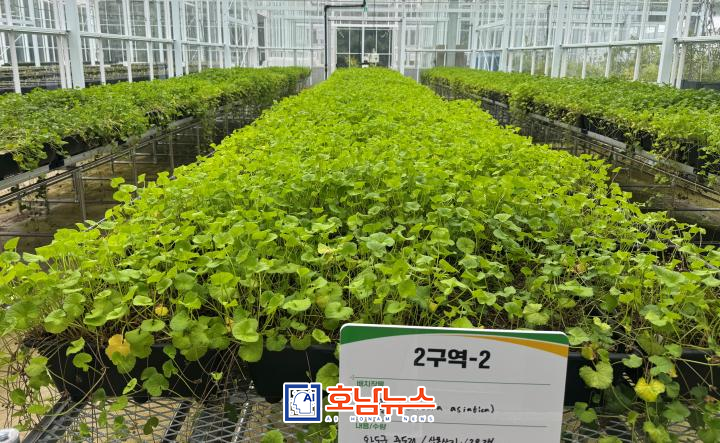 전남산림연구원 병풀 / 사진제공=전라남도 |
전라남도산림연구원(원장 오득실)은 화장품·식품·의약 소재 등 고부가가치 산업에 활용되는 산림바이오 소재 ‘병풀(Centella asiatica)’을 대상으로 신품종 출원과 재배 표준화 연구를 본격 추진한다고 밝혔다.
병풀은 ‘호랑이풀’로도 알려진 다년생 초본식물로, 고온다습한 기후를 선호해 전남·제주 등 남부 지역에 주로 자생한다.
특히 아시아티코사이드, 마데카식산 등 생리활성 물질을 다량 함유하고 있어 항염증 및 피부 재생 효능이 뛰어난 것으로 보고되며, 최근 K-뷰티 산업의 핵심 원료로 큰 주목을 받고 있다.
그러나 국내 산업계는 여전히 원료의 대부분을 수입에 의존하고 있으며, 국내 재배 농가가 적어 생산량이 부족한 실정이다. 또한 기능성 성분 함량이 높은 품종 개발과 재배 표준화 연구도 미흡해 국산 원료의 경쟁력 강화가 시급한 상황이다.
전남산림연구원은 이러한 문제 해결을 위해 병풀 자생지를 직접 조사해 우량 개체를 확보하고, 생리활성 물질 함량 및 생육 특성을 분석해 신품종 개발을 위한 선발 연구를 추진해왔다.
현재 연구 중인 선발 개체는 일반 자생종에 비해 잎 길이·너비가 약 1.5배 크고, 엽병(잎자루) 길이가 3.2배 길어, 생산성과 수확 효율이 크게 향상된 것으로 나타났다.
연구원은 이 가운데 기능성 지표성분 함량이 우수한 개체를 최종 선발해 신품종 출원 및 재배 매뉴얼 개발을 추진할 계획이다.
이번 연구가 완료되면 국내 임가가 고기능성 병풀을 안정적으로 재배할 수 있는 기반이 마련되고, 현재 수입에 의존하는 화장품·식품 원료를 국산 원료로 대체하는 전환점이 될 것으로 기대된다.
오득실 전남산림연구원장은 “산림바이오 소재의 신품종 개발과 재배법 표준화 연구는 임가와 기업이 함께 성장하는 산업 생태계 조성의 중요한 첫 단계”라며 “병풀을 비롯한 전남의 우수 산림바이오 소재 발굴·육성에 지속적으로 힘쓰겠다.”고 말했다.
[Jeonnam = News Channel] newscheaner@kakao.com
Jeonnam Forest Research Institute Begins Development of New ‘Centella asiatica’ Varieties to Lead K-Beauty
― Expected to Boost Domestic Production of High-Value Cosmetic, Food, and Pharmaceutical Materials ―
The Jeonnam Forest Research Institute (Director: Oh Deuk-sil) announced that it has begun full-scale research aimed at filing new variety registrations and establishing standardized cultivation manuals for Centella asiatica, a high-value forest bio-material widely used in cosmetics, food, and pharmaceutical industries.
Commonly known as “tiger grass,” Centella asiatica is a perennial herb that thrives in warm and humid climates, and is mainly found in the southern regions of Korea, including Jeonnam and Jeju.
The plant contains high levels of bioactive compounds such as asiaticoside and madecassic acid, which are known for their anti-inflammatory and skin-regeneration effects. As such, Centella asiatica has recently gained prominence as a core ingredient in the global K-beauty industry.
However, most of the raw material used domestically is still imported, and only a limited number of farms cultivate the plant, resulting in insufficient domestic production. Furthermore, research on developing varieties with higher concentrations of functional compounds and on standardized cultivation practices remains inadequate, underscoring an urgent need to strengthen the competitiveness of domestic raw materials.
To address these challenges, the Jeonnam Forest Research Institute has conducted field surveys to identify high-quality native specimens and analyzed their bioactive compound levels and growth traits as part of its efforts to develop new varieties.
According to the institute, the selected candidate varieties show significantly improved characteristics compared to naturally occurring forms:
their leaves are approximately 1.5 times longer and wider, and their petioles are 3.2 times longer, contributing to higher productivity and improved harvesting efficiency.
The institute plans to select the most promising individuals—those with exceptionally high concentrations of key functional compounds—for new variety registration and the development of standardized cultivation manuals.
Once the research is completed, it is expected to provide Korean forest farmers with a stable foundation for cultivating high-functionality Centella asiatica. It will also serve as a turning point in replacing imported raw materials with domestically produced alternatives for cosmetics and food industries.
Director Oh Deuk-sil of the Jeonnam Forest Research Institute stated,
“Developing new forest bio-material varieties and standardizing cultivation methods are essential first steps toward building an industrial ecosystem where both farmers and businesses can grow together. We will continue to discover and nurture Jeonnam’s outstanding forest bio-resources, including Centella asiatica, and conduct practical research that directly supports the field.”
 박인석 기자 newscheaner@kakao.com