2026.05.02 (토) 13:19




 닫기
닫기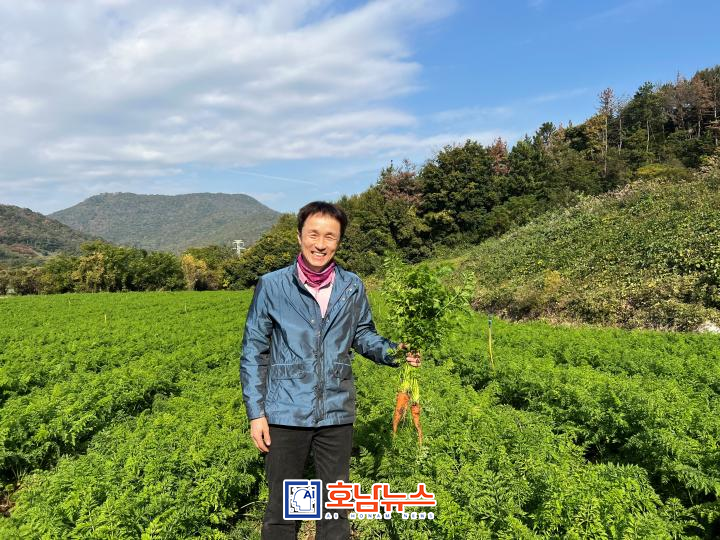 친환경농산물-무농약 당근 재배(여수시 율촌면 류용현)사진제공전라남도 |
전라남도가 11월 ‘이달의 친환경농산물’로 여수 율촌면에서 재배되는 당근을 선정했다.
비타민A의 전구체인 베타카로틴이 풍부한 당근은 눈 건강과 면역력 강화에 도움이 되고, 식이섬유가 많아 장 건강에도 좋은 대표적 건강채소다.
여수 산 당근은 국내 최대 주산지인 제주산과 달리 조직이 단단하고 저장성이 높아, 학교급식과 대량 유통업체에서 큰 인기를 얻고 있다.
여수 율촌면에서 10여 년째 친환경 당근 재배를 이어가고 있는 류용현(53) 씨는 원래 축산업을 하다 농업으로 전향한 뒤, 지역 농가들과 함께 학교급식용 친환경 당근 재배를 시작했다.
현재 2만 4천800㎡(7천500평) 규모의 밭에서 봄에는 감자, 가을에는 당근을 재배하며, 연간 약 50톤의 친환경 당근을 생산한다.
생산량의 70%는 여수·순천·광양 등 학교급식용으로 공급되고, 나머지 30%는 온라인 직거래 플랫폼 ‘농라’ 등을 통해 판매된다. 이를 통해 연간 약 9천만 원의 소득을 올리고 있다.
류 씨는 비닐 멀칭 재배법을 도입해 생육 기간을 단축하고 잡초 발생을 줄이는 한편, 여수 지역의 점질토 토양 특성에 맞춰 퇴비 투입과 휴경으로 지력 관리를 실천하고 있다.
또, 승용방제기(SS기)를 활용한 정밀 해충 방제로 친환경 농업의 품질을 높이고 있다.
그는 “친환경 농산물이 일반 농산물보다 높은 가격을 받는 것은 아니지만, 가치를 이해하는 소비자들이 꾸준히 찾아주기 때문에 안정적인 판로를 유지할 수 있다”며 “앞으로도 믿을 수 있는 당근을 생산해 율촌면 친환경 당근의 품질과 경쟁력을 높이겠다.”고 말했다.
현재 전남지역의 친환경농업 재배면적은 3만 5천328ha로, 전국 7만 428ha의 50.2%를 차지하며 전국 1위를 지키고 있다.
김영석 전라남도 친환경농업과장은 “친환경농업의 가치를 묵묵히 지켜가는 농가 덕분에 소비자들이 안전하고 건강한 먹거리를 누릴 수 있다”며 “이들의 노력이 결실을 맺도록 세심히 지원해, 전남형 친환경농업이 더욱 확고히 자리 잡을 수 있도록 하겠다.”고 밝혔다.
[Jeonnam = News Channel] newscheaner@kakao.com
“Yeosu’s Eco-Friendly Carrots Nourish Even School Meals!”
Jeonnam Province selects Yeosu Yulchon carrots as November’s ‘Eco-Friendly Agricultural Product of the Month’
― Farmer Ryu Yong-hyun practices soil management and eco-friendly pest control… Produces 50 tons annually with 90 million won in income ―
Jeollanam-do Province has selected “Yeosu carrots” cultivated in Yulchon-myeon, Yeosu, as November’s Eco-Friendly Agricultural Product of the Month.
Carrots, rich in beta-carotene, a precursor to vitamin A, are known to promote eye health and strengthen immunity. They are also high in dietary fiber, which aids digestion. In particular, Yeosu-grown carrots are firmer and have better storability than those from Jeju, the nation’s largest carrot-producing region, making them popular for school meals and large distributors.
Mr. Ryu Yong-hyun (53), who has been cultivating eco-friendly carrots in Yulchon-myeon for over a decade, switched from livestock farming to agriculture and began growing carrots for school meals in collaboration with local farmers.
He currently cultivates about 24,800 square meters (7,500 pyeong) of farmland, producing around 50 tons of eco-friendly carrots annually. About 70% of the harvest is supplied to school meal programs in Yeosu, Suncheon, and Gwangyang, while the remaining 30% is sold directly to consumers through online platforms such as “Nongra.” His annual income from these activities reaches approximately 90 million won.
Ryu has introduced the plastic mulch cultivation method, which shortens the growing period and suppresses weed growth. He also practices soil fertility management by alternating compost application and fallow periods suited to Yeosu’s clay-rich soil. In addition, he utilizes a self-propelled sprayer (SS sprayer) for precision pest control to further enhance eco-friendly farming practices.
“Eco-friendly produce doesn’t necessarily sell for higher prices than conventional crops,” Ryu said, “but consumers who value eco-friendly practices continue to support us, allowing for a stable market. I’ll continue producing trustworthy crops to strengthen the quality and competitiveness of Yulchon’s eco-friendly carrots.”
As of now, Jeollanam-do’s eco-friendly farming area totals 35,328 hectares, accounting for 50.2% of the national total (70,428 ha)—the highest proportion in the country.
Kim Young-seok, Director of the Eco-Friendly Agriculture Division of Jeonnam Province, remarked, “Thanks to the dedication of farmers who steadfastly uphold the value of eco-friendly agriculture, consumers can enjoy safe and healthy food. We will continue to provide tailored support so that ‘Jeonnam-style eco-friendly farming’ can take deeper root and flourish.”
 박인석 기자 newscheaner@kakao.com