2026.04.16 (목) 21:39




 닫기
닫기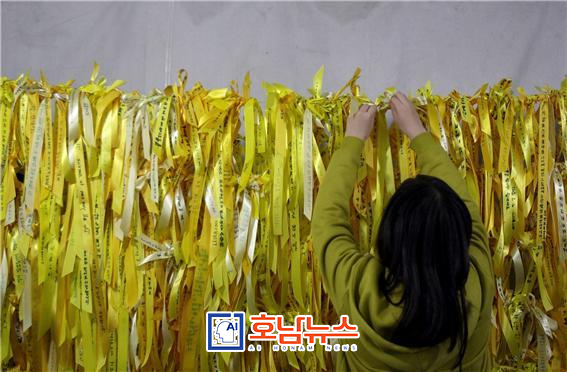 단원고 학생들의 안타까움을 전하는 리본 / 사진제공=chat gpt |
【전남=AI호남뉴스】 aihnnews@kakao.com
세월호 참사 12주년을 맞은 올해 봄, 우리는 다시 그날의 바다 앞에 서게 된다.
계절은 어김없이 돌아왔지만, 2014년 4월 16일에 멈춘 시간은 여전히 현재진행형이다.
기억은 희미해지지 않았고, 오히려 더 또렷해진 질문으로 우리 사회를 향하고 있다.
이번 12주년 기억식은 여러 의미에서 특별했다. 이재명 대통령이 처음으로 공식 참석하며 국가의 책임을 다시 한 번 환기시켰고, 그동안 감춰져 있던 기록들이 대규모로 공개되면서 그날의 진실은 다시 공론의 중심으로 떠올랐다.
약 12만 건에 달하는 자료 공개는 단순한 행정 조치가 아니라, “무엇이 잘못되었는가.”라는 근본적인 질문을 다시 사회 전체에 던지는 계기가 됐다.
세월호는 단순한 해상 사고가 아니었다.
304명의 희생자는 숫자가 아니라 이름이었고, 각각의 삶이었으며, 아직 펼쳐지지 못한 미래였다.
특히 안산 단원고 학생들의 빈자리는 시간이 지나도 채워지지 않는 상징으로 남아 있다.
살아 있었다면 서른이 되었을 아이들, 그들이 누렸어야 할 평범한 일상이 사라졌다는 사실은 지금도 많은 이들의 가슴을 무겁게 한다.
유가족과 생존자들의 시간은 더욱 느리게 흐르고 있다.
그들에게 12년은 결코 ‘지난 시간’이 아니라, 매일 반복되는 현재다.
“꼭 한 번만 보고 싶다”는 절절한 외침은 여전히 이어지고 있고, 바다 위에 홀로 떠 있는 부표는 그리움과 상실을 상징하듯 조용히 자리를 지키고 있다.
기억은 단순한 추모를 넘어, 감내해야 하는 고통이자 끝내 놓을 수 없는 관계로 남아 있다.
선상에서 진행된 추모식에는 40여 명이 참여해 바다 위에서 다시 그날을 마주했다.
물결은 여전히 잔잔했지만, 그 위에 흐르는 감정은 결코 잔잔하지 않았다. 돌아오지 못한 이들을 향한 마음, 그리고 끝내 닿지 못한 시간에 대한 안타까움이 바다 위를 채웠다.
세월호 선체는 이제 녹슬어 있지만, 그 안에 담긴 기억은 조금도 사라지지 않았다. 오히려 시간의 흔적이 더해질수록 그날의 아픔은 더 선명해지고 있다. 선체는 말없이 우리에게 묻는다. “이 사회는 과연 달라졌는가.”라고.
그 질문 앞에서 우리는 쉽게 답하지 못한다.
세월호 이전과 이후를 나누는 기준은 분명 존재하지만, 그 기준이 실제 변화로 이어졌는지에 대해서는 여전히 논쟁이 이어지고 있기 때문이다.
재난 대응 체계, 책임 구조, 안전 의식 등 여러 분야에서 개선이 있었다고 말하지만, 여전히 반복되는 사고와 미흡한 대응은 그 변화가 충분하지 않았음을 보여준다.
결국 세월호는 기억의 문제가 아니라 책임의 문제다.
그리고 그 책임은 감정이 아닌 정책으로 이어져야 한다.
기록 공개는 시작일 뿐이며, 그 기록을 통해 진실을 밝히고, 제도를 바꾸며, 같은 비극이 반복되지 않도록 하는 것이야말로 국가가 져야 할 의무다.
12번째 봄, 우리는 다시 묻는다.
기억하고 있는가, 그리고 바꾸고 있는가.
세월호의 아픔은 여전히 현재이며, 그 바다는 아직 건너지 못한 채 우리 앞에 남아 있다.
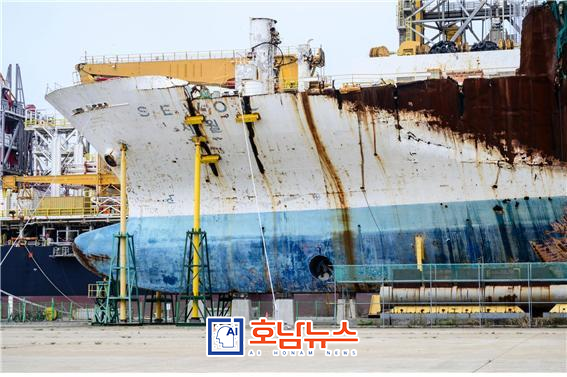 인양된 세월호 / 사진제공=chat gpt |
【Column】
【Jeonnam = AI Honam News】 aihnnews@kakao.com
“The Sea of That Day Has Not Yet Ended”
Subtitle: The 12th Spring—Memory Remains, and Responsibility Still Calls
In the spring marking the 12th anniversary of the Sewol ferry disaster, we once again find ourselves standing before the sea of that day.
The seasons have faithfully returned, but the time that stopped on April 16, 2014, still remains in the present. Memory has not faded; rather, it has sharpened into a clearer question directed at our society.
This year’s 12th memorial ceremony carried special significance in many ways. Lee Jae-myung President Lee Jae-myung attended for the first time in an official capacity, once again bringing the issue of state responsibility to the forefront. At the same time, a massive release of previously undisclosed records has brought the truth of that day back into the center of public discourse.
The disclosure of approximately 120,000 documents is not merely an administrative act—it is a renewed call to ask a fundamental question: “What went wrong?”
The Sewol ferry disaster was not simply a maritime accident.
The 304 victims were not numbers, but names—each representing a life, a story, and a future that was never allowed to unfold.
In particular, the empty seats left behind at Danwon High School in Ansan remain a symbol that time cannot fill.
Had they lived, they would now be thirty years old.
The fact that their ordinary lives were taken away continues to weigh heavily on our hearts even today.
For the bereaved families and survivors, time moves far more slowly.
For them, these 12 years are not “the past,” but a reality that repeats itself every day.
The desperate cry—“I just want to see them one more time”—still echoes, and a solitary buoy floating on the sea quietly stands as a symbol of longing and loss.
Memory, in this sense, is not merely remembrance.
It is pain to be endured, and a bond that cannot be let go.
A memorial ceremony held at sea, attended by around 40 people, once again faced that day upon the waters.
The waves were calm, but the emotions flowing above them were anything but.
Longing for those who never returned, and sorrow for the time that never reached them, filled the sea.
The Sewol ferry itself now lies rusted, yet the memory it holds has not faded in the slightest.
If anything, the passage of time has only made the pain more vivid.
Silently, the vessel asks us a question: “Has this society truly changed?”
Before that question, we struggle to answer.
Although there is a clear line dividing before and after Sewol, whether that line has led to real change remains a subject of ongoing debate.
Improvements have been claimed in disaster response systems, accountability structures, and safety awareness, yet repeated incidents and inadequate responses suggest that such changes are still not enough.
In the end, Sewol is not merely an issue of memory—it is an issue of responsibility.
And that responsibility must extend beyond emotion into policy.
The release of records is only a beginning. Through them, the truth must be revealed, systems must be reformed, and measures must be established to ensure that such a tragedy never happens again. That is the duty of the state.
In this 12th spring, we ask once more:
Do we remember? And are we changing?
The pain of Sewol is still present.
And the sea of that day remains before us—un-crossed, unresolved.
 ai호남뉴스 박충배 편집/칼럼/논설 aihnnewsr@kakao.com